
Business Software · Researched comparison

Best GitLab Alternatives (2026): 6 Options Compared

TaskReports may earn a fee from some links on this page, and some placements are paid and labelled. Neither one decides the order. See our disclosure.

The short answer

SourceHut leads the list, best for developers who prefer email driven patch workflows and a minimal, quick interface. Alternatives: Bitbucket for teams that already use Jira and Confluence and want tight Atlassian integration, and GitHub for most teams that want the largest ecosystem, strong CI/CD and a free level.

On this page

Key takeaways

  • The list opens with SourceHut, aimed at developers who prefer email driven patch workflows and a minimal, fast interface.
  • RhodeCode fits enterprises that still run Mercurial or Subversion alongside Git.
  • The cheapest monthly starting price in the list is $3.65/user/mo, Standard plan, offered by Bitbucket.
  • The main caution on GitHub: advanced security and SAML single sign-on sit on the Enterprise level at 21 dollars per user a month, and self-hosting needs that level.
  • 5 of 6 tools offer a free plan: Bitbucket, GitHub, Gerrit, Perforce Helix Core, RhodeCode.

Quick comparison

ToolSuited toPrice fromWatch out for
------------
SourceHutDevelopers who prefer email driven patch workflows and a minimal, quick interface$5/mo, standard Amateur Hacker rate from Jan 2026The service is still described as alpha
BitbucketTeams that already use Jira and Confluence and want tight Atlassian integration$3.65/user/mo, Standard planThe free tier covers only five users and 50 build minutes
GitHubMost teams that want the largest ecosystem, capable CI/CD and a free level$4/user/mo, Team planSelf-hosting needs that tier
GerritLarge teams that require strict, patchset based code review at scale$0, open source, no licensing feesSetup needs a Java runtime and an administrator who knows its model
Perforce Helix CoreGame studios and media teams with huge binary assets and large files$39/user/mo, P4 Cloud managed planIt is not Git, so Git workflows
RhodeCodeEnterprises that still run Mercurial or Subversion alongside Git$6.25/user/mo, Enterprise Edition, annual billing, minimum 10 usersThe vendor pricing page shows no dollar figures

How we chose

The comparison looks at four things: starting price, free access, how well the feature set matches GitLab, and the main limit of each tool. Where a price is missing, the vendor does not list one publicly or ties it to a quote. Always confirm before budgeting. The order reflects how well each tool fits the most common buying scenario for GitLab, then price clarity, then free plan access. It is a starting point, not a verdict.

★ Best overall

SourceHut

Developers who prefer email driven patch workflows and a minimal, quick interface

  • Completely open source and self-hostable
  • Mailing list patch workflows
Price$5/mo, standard Amateur Hacker rate from Jan 2026; reduced $2/mo rate available
See SourceHut pricing

Where SourceHut fits: developers who prefer email driven patch workflows and a minimal, quick interface. Standard rates from January 2026 are 5, 10 and 15 dollars per month, with a 2 dollar reduced rate. Where it falls short: The patch by email model is a culture shock for teams raised on pull requests. The starting price for SourceHut: $5/mo, standard Amateur Hacker rate from Jan 2026. Free access: Payment optional during alpha for most features, financial aid available.

Price: $5/mo, standard Amateur Hacker rate from Jan 2026; reduced $2/mo rate available

Free plan: Payment optional during alpha for most features, financial aid available

Website: sr.ht

Watch out for

  • The service is still described as alpha
2

Bitbucket

Teams that already use Jira and Confluence and want tight Atlassian integration
$3.65/user/mo, Standard plan; Premium $8/user/mo
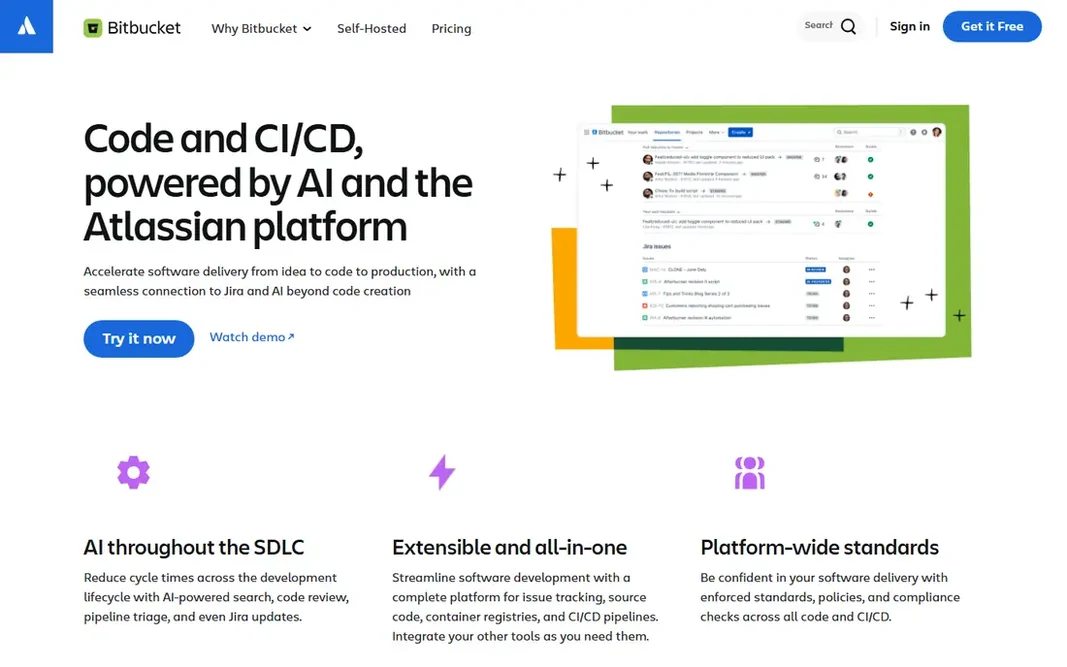
Bitbucket was built for teams that already use Jira and Confluence and want tight Atlassian integration. Bitbucket is the natural pick for a team that already lives in Jira, since issues, branches and pull requests link straight to Jira tickets. Premium at 8 dollars brings merge checks, IP allowlisting, deployment permissions and required two step verification. Bitbucket pricing: $3.65/user/mo, Standard plan. Bitbucket includes a free tier. What users get: simple pricing. Limits to weigh: the ecosystem is smaller than GitHub, so niche integrations may be missing.

Free plan: Yes

Website: bitbucket.org

Strengths

  • Built in Pipelines CI/CD
  • Data Center choice for self-managed hosting

Watch out for

  • The free level spans only five users and 50 build minutes
3

GitHub

Most teams that want the largest ecosystem, capable CI/CD and a free level
$4/user/mo, Team plan; Enterprise $21/user/mo

GitHub is a good fit for most teams that want the largest ecosystem, solid CI/CD and a free level. Enterprise at 21 dollars layers on Copilot, audit logs, SAML single sign-on and 50,000 Actions minutes. Where it falls short: Advanced security and SAML single sign-on sit on the Enterprise level at 21 dollars per user a month. Highlights: Dependabot security updates. What you pay to start with GitHub: $4/user/mo, Team plan. A free plan is available with GitHub.

Free plan: Yes

Website: github.com

Strengths

  • Copilot included on Enterprise
  • Largest developer community and integration library

Watch out for

  • Self-hosting needs that tier
4

Gerrit

Large teams that require strict, patchset based code review at scale
$0, open source, no licensing fees

Gerrit is aimed squarely at large teams that require strict, patchset based code review at scale. It is 100 percent open source, and the site displays version 3.14.5 as current. Price to start with Gerrit: $0, open source, no licensing fees. You can start on Gerrit without paying. Trade-offs to know: setup needs a Java runtime and an administrator who knows its model. What works well: Patchset based review with fine grained permissions.

Free plan: Yes

Website: gerritcodereview.com

Strengths

  • Proven at thousands of developers
  • 100 plus community plugins

Watch out for

  • It is a review system instead of a full forge, so issue tracking and CI must come from other tools
5

Perforce Helix Core

Game studios and media teams with huge binary assets and large files
$39/user/mo, P4 Cloud managed plan; self-hosted Scale and Platform plans by quote

Perforce Helix Core is built with game studios and media teams with huge binary assets and large files in mind. P4 Cloud costs 39 dollars per user a month for teams of up to 100, with 64 GiB of storage and 64 GiB of monthly egress included. Worth adding: Perforce Helix Core, now branded Perforce P4, is the pick for teams whose repositories are mostly large binary files, for example game art, video and CAD models, where Git struggles. The starting price for Perforce Helix Core: $39/user/mo, P4 Cloud managed plan. Perforce Helix Core offers a free plan. Where it is weaker: the self-hosted Scale and Platform plans are quote only. Upsides: trusted by game and film studios.

Free plan: Yes

Website: perforce.com

Strengths

  • Managed P4 Cloud removes the server work
  • Manages very large files and binary assets far better than Git

Watch out for

  • Pull requests and the Git ecosystem do not apply
6

RhodeCode

Enterprises that still run Mercurial or Subversion alongside Git
$6.25/user/mo, Enterprise Edition, annual billing, minimum 10 users; third-party reported, vendor page shows no dollar figure

RhodeCode serves enterprises that still run Mercurial or Subversion alongside Git. Its Community Edition is free and open source, whereas Enterprise brings support, enterprise authentication and workflow automation. In daily use, the vendor page confirms the ten seat minimum and multi-year discounts, but presents no dollar figures. On cost, RhodeCode starts like this: $6.25/user/mo, Enterprise Edition, annual billing, minimum 10 users. Free access exists with RhodeCode. What to check first: Enterprise seats come in packs of ten with a ten user minimum.

Free plan: Yes

Website: rhodecode.com

Strengths

  • Granular permissions and audit logs
  • One system for Git

Watch out for

  • The vendor pricing page presents no dollar figures

FAQ

Is SourceHut the right pick for everyone comparing GitLab?

No single tool suits every team. SourceHut comes first because it fits developers who prefer email driven patch workflows and a minimal, fast interface, while Bitbucket suits teams that already use Jira and Confluence and want tight Atlassian integration and GitHub suits most teams that want the largest ecosystem, strong CI/CD and a free tier. Match the tool to your own size, budget and workflow before deciding.

Do these tools publish their prices?

Yes. Every tool from SourceHut to RhodeCode shows a starting price, though seats, add-ons and billing terms still change the final cost.

Which GitLab alternative is a good match for self-hosting?

Start with SourceHut if you need developers who prefer email driven patch workflows and a minimal, quick interface. Bitbucket is the better match for teams that already use Jira and Confluence and want tight Atlassian integration, and GitHub for most teams that want the largest ecosystem, strong CI/CD and a free level. The best choice depends on budget, team size and workflow.

Can I try these tools before paying?

Often, yes. Bitbucket, GitHub, Gerrit and others have a free plan. Use your own data and a real task during the test, and check what the free tier or trial limits before you rely on it.

How are the tools for GitLab ordered?

SourceHut sits first and RhodeCode last because the order follows typical fit for GitLab, then price clarity and free access. It is a judgement call, so read each profile for fit and limits.