Developer Tools · Researched comparison

7 Best Augmented Reality Ar Sdk Software for 2026

TaskReports may earn a fee from some links on this page, and some placements are paid and labelled. Neither one decides the order. See our disclosure.

The short answer

Our first pick is EasyAR, best for budget-friendly cross-platform AR development. Look at MAXST for visual SLAM and AR smart glasses, and at Unity (AR Foundation) for one codebase for iPhone and Android AR. Prices, free plans and limits for all 7 tools follow.

On this page

Key takeaways

  • Top of the list is EasyAR, which targets low-cost cross-platform AR development.
  • A fair warning about Unity (AR Foundation): Pro price rose to $2,310 per seat a year in January 2026.
  • Only 5 of the 7 tools have a free plan (EasyAR, Unity (AR Foundation), Onirix, Google ARCore, Apple ARKit), so check the caps.
  • For iOS apps with the best possible tracking, Apple ARKit is worth a look.

Quick comparison

ToolBest forFree planOfficial site
------------
EasyARLow-cost cross-platform AR developmentYeseasyar.com
MAXSTVisual SLAM and AR smart glassesFree trialmaxst.com
Unity (AR Foundation)One codebase for iPhone and Android ARYesunity.com
OnirixAgencies shipping WebAR quickYesonirix.com
ZapparMarketing teams building AR without developersFree trialzappar.com
Google ARCoreAndroid AR and location-based experiencesYesdevelopers.google.com
Apple ARKitIOS apps with the best possible trackingYesdeveloper.apple.com
★ Best overall

EasyAR

Low-cost cross-platform AR development

  • Free Personal level for learning
  • Professional plan at $39 a month undercuts most rivals
Price$39/month (Professional)
See EasyAR pricing

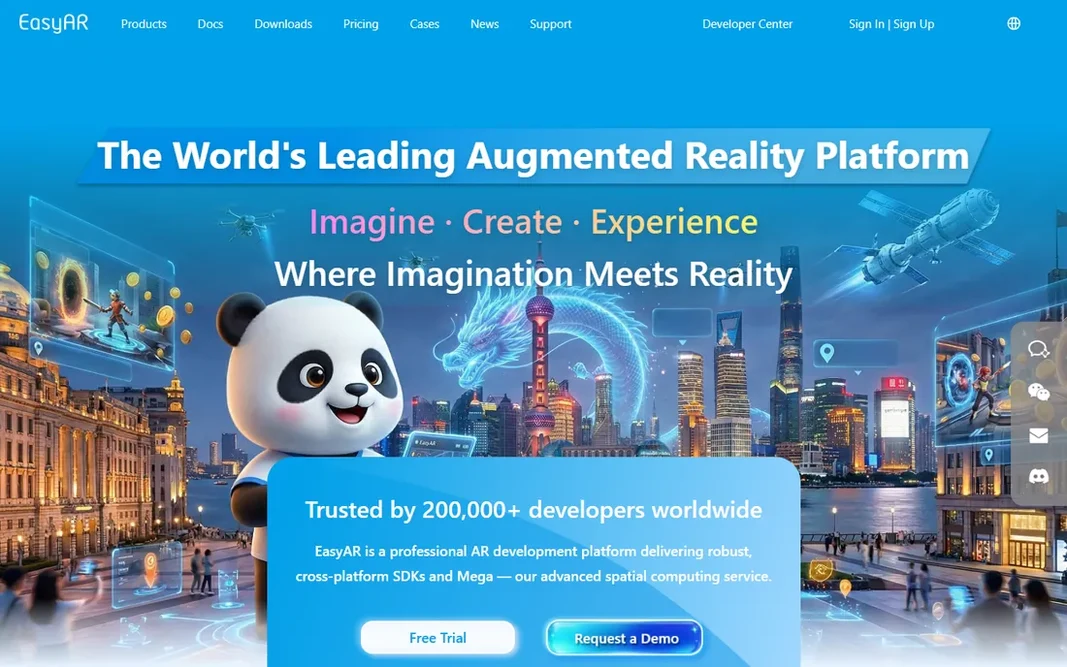
EasyAR is built with budget-friendly cross-platform AR development in mind. The Professional edition is $39 per month with no watermark and no session limits, and a one-time Classic license exists at $1,399. The free Personal edition is genuinely usable for prototyping but presents a watermark and caps sessions at 100 seconds per run. What you pay to start with EasyAR: $39/month. You can start on EasyAR without paying. Where it is weaker: Documentation and community are thinner than Unity's.

Price: $39/month (Professional)

Free plan: Yes

Website: easyar.com

Watch out for

  • Personal level carries a watermark and a 100-second per-run limit
2

MAXST

Visual SLAM and AR smart glasses
$59/month (Pro subscription, per license)

MAXST works best for visual SLAM and AR smart glasses. The SDK spans image, object, and cloud recognition, supports external camera input and AR smart glasses, and MAXST's VPS service makes it possible for AR navigation and advertising with accurate indoor and outdoor positioning. More specifically, over 10,000 developers in more than 50 countries use it. The starting price for MAXST: $59/month. Trial and free access: Free trial. Where it falls short: Enterprise pricing needs direct consultation.

Free plan: Free trial

Website: maxst.com

Strengths

  • Sensor Fusion SLAM works without spatial limits
  • Supports external cameras and smart glasses

Watch out for

  • Smaller developer community than Vuforia or EasyAR

3

Unity (AR Foundation)

One codebase for iPhone and Android AR
Free (Personal tier); Pro $2,310/seat/year

Unity (AR Foundation) is aimed squarely at one codebase for iPhone and Android AR. Unity with AR Foundation is the workhorse of commercial AR development. The Unity editor manages the full pipeline from prototyping to device testing. Where it falls short: App install required, so no reach like WebAR. The asset store has plugins for nearly every AR trick worth doing. The honest math starts with Unity's own levels: Personal is free under $200,000 in trailing revenue, and Pro is $2,310 per seat a year as of January 2026. Worth adding: for an agency building client AR apps, seats add up quick, and Unity's terms tie level eligibility to the client's revenue on contract work. On cost, Unity (AR Foundation) starts like this: Free. Unity (AR Foundation) includes a free tier.

Free plan: Yes

Website: unity.com

Strengths

  • Huge asset store and developer community
  • Deploy to ARKit and ARCore

Watch out for

  • Pro price rose to $2,310 per seat a year in January 2026
4

Onirix

Agencies shipping WebAR quick
See website

Onirix is designed for agencies shipping WebAR quick. Onirix, from Spain, positions itself as the adaptable WebAR product for agencies. Honest limits: Smaller ecosystem than 8th Wall. A free version exists for getting started. Check the vendor site for Onirix pricing; none is listed in this comparison. Free access exists with Onirix.

Free plan: Yes

Website: onirix.com

Strengths

  • Free version available
  • Proprietary tracking tuned for iOS and Android browsers

Watch out for

  • Pricing information is inconsistent across sources
5

Zappar

Marketing teams building AR without developers
$12.99/month (ZapWorks Developer)

Think of Zappar for marketing teams building AR without developers. Recent additions contain WebXR support and Zapworks Spaces for indoor navigation. The system also supplies a free trial to test the tools. Watch-outs: The $12.99 plan is non-commercial. Designer is a drag-and-drop no-code editor, Mattercraft is the full scriptable 3D environment for developers. The Universal AR libraries bring Zappar's tracking into Three.js, Unity, A-Frame, and Babylon.js. On cost, Zappar starts like this: $12.99/month. Trial and free access: Free trial.

Free plan: Free trial

Website: zappar.com

Strengths

  • No-code Designer plus Mattercraft for developers
  • Universal AR libraries for Three.js and Unity

Watch out for

  • Ecosystem is Zappar-centric
6

Google ARCore

Android AR and location-based experiences
Free

Google ARCore makes the most sense for Android AR and location-based experiences. ARCore is Google's answer to ARKit and the only serious native choice for Android. Its headline differentiator is the Geospatial API, which uses Google's visual positioning to anchor AR content to real-world locations at city scale, the tech behind games like SPACE INVADERS: World Defense. Downsides: Android device support is fragmented across manufacturers. Beyond that, cloud Anchors let several users see the same AR content in the same place. Distribution is the usual Android caveat: ARCore works on a broad but not universal device list, and tracking quality varies by phone. Price to start with Google ARCore: Free. Google ARCore has a free plan.

Free plan: Yes

Website: developers.google.com/ar

Strengths

  • Cloud Anchors for shared multi-user experiences
  • Free with solid Unity and WebXR support

Watch out for

  • IOS support exists but is secondary to ARKit
7

Apple ARKit

IOS apps with the best possible tracking
Free (Apple Developer Program $99/year to publish apps)

Apple ARKit was built for iOS apps with the best possible tracking. It ships with iOS, hands direct access to plane detection, image and object tracking, face tracking, location anchors, and LiDAR-powered scene reconstruction on Pro devices. The trade is the product wall. What to check first: Publishing to the App Store needs the $99 a year developer membership. For utility apps, games, and retail experiences where iPhone dominates the audience, that is a fair trade. In daily use, ARKit itself costs nothing beyond the standard $99 a year Apple Developer Program membership. The hardware-software pairing means tracking quality no cross-platform abstraction can quite match. Entry price for Apple ARKit: Free. Apple ARKit includes a free tier.

Free plan: Yes

Website: developer.apple.com

Strengths

  • No SDK licensing cost
  • Vision Pro

Watch out for

  • IOS only, so Android users are excluded

FAQ

What is the cheapest option for augmented reality ar sdk software in this list?

On published monthly entry prices, Zappar is the lowest here at $12.99/month. Entry price is only part of the cost, because seats, add-ons and billing terms can change the total.

Is EasyAR the right pick for everyone comparing augmented reality ar sdk software?

No single tool suits every team. EasyAR comes first because it fits affordable cross-platform AR development, while MAXST suits visual SLAM and AR smart glasses and Unity (AR Foundation) suits one codebase for iPhone and Android AR. Match the tool to your own size, budget and workflow before deciding.

Do these tools publish their prices?

Not all of them. Onirix publishes no starting price, so expect a quote request for it. The rest, EasyAR included, show a starting price, though seats and billing terms still change the final cost.

What is the cheapest way to add AR to an existing app?

If your app is already built in Unity, AR Foundation layers on AR support with no SDK licensing fee, just your Unity seat costs.

Which AR SDK is a good match for beginners?

This list starts with EasyAR, which fits budget-friendly cross-platform AR development. For other needs, MAXST is aimed at visual SLAM and AR smart glasses, and Unity (AR Foundation) at one codebase for iPhone and Android AR. Check each tool's price and main limit first.

How are the tools for augmented reality ar sdk software ordered?

EasyAR sits first and Apple ARKit last because the order follows typical fit for augmented reality ar sdk software, then price clarity and free access. It is a judgement call, so read each profile for fit and limits.