
HR and Workforce · Researched comparison

How to Pick Compensation Management Software: 6 Tools Compared

TaskReports may earn a fee from some links on this page, and some placements are paid and labelled. Neither one decides the order. See our disclosure.

The short answer

This list puts Lattice Compensation first for SMBs and mid-market businesses already running Lattice for performance. If your case is different, Salary.com CompAnalyst suits Compensation teams needing deep survey data and formal salary structures and Carta Total Comp suits US-based, VC-backed startups already on Carta for cap-table management. All 6 tools are compared below on price, free plan and limits.

On this page

Key takeaways

  • Top of the list is Lattice Compensation, which targets SMBs and mid-market firms already running Lattice for performance.
  • Neither Lattice Compensation nor SimplyMerit, nor any of the other 4 tools, has a permanent free plan; trials and quotes are the norm.
  • For the cheapest start, look at Lattice Compensation: $6/seat/month.
  • For mid-sized firms (200-5,000 employees) that want to kill the merit-cycle spreadsheet, SimplyMerit is worth a look.

Quick comparison

ToolBest fitFree tierVendor site
------------
Lattice CompensationSMBs and mid-market firms already running Lattice for performanceNolattice.com
Salary.com CompAnalystCompensation teams needing deep survey data and formal salaryNosalary.com
Carta Total CompUS-based, VC-backed startups already on Carta for cap-table managementNocarta.com
PaveHigh-growth US tech startups making gives you weeklyNopave.com
Deel CompensationGlobally distributed startups and mid-market businessesNodeel.com
SimplyMeritMid-sized businesses (200-5,000 employees)Free trialsimplymerit.com
★ Best overall

Lattice Compensation

SMBs and mid-market firms already running Lattice for performance

  • Highly rated usability with capable HRIS integrations
  • Published per-seat pricing is rare in this category
Price$6/seat/month (add-on to a Lattice base product; $4,000 minimum annual agreement, billed annually)
See Lattice Compensation pricing

Lattice Compensation works best for SMBs and mid-market businesses already running Lattice for performance. Lattice Compensation is the workflow pick for businesses standardizing performance and pay in one place: merit cycles run straight on review data, no second system, no CSV exports. The $4,000 annual minimum means sub-80-seat teams pay more per head than the headline recommends. It needs a Lattice base product (Foundations from $13/seat/month). It is a workflow tool with benchmarking attached, not a data powerhouse: pair it with an external survey for deep market cuts. On top of that, best for firms already on Lattice; others should price the entire stack. Entry price for Lattice Compensation: $6/seat/month. Lattice Compensation has no permanent free option. Watch-outs: Needs a Lattice base product: the $6/seat sits on top of Performance/Engagement seats.

Price: $6/seat/month (add-on to a Lattice base product; $4,000 minimum annual agreement, billed annually)

Free plan: No

Website: lattice.com

Watch out for

  • The $4,000 annual minimum prices out tiny teams
2

Salary.com CompAnalyst

Compensation teams needing deep survey data and formal salary structures
See website (quote-based; no published pricing)

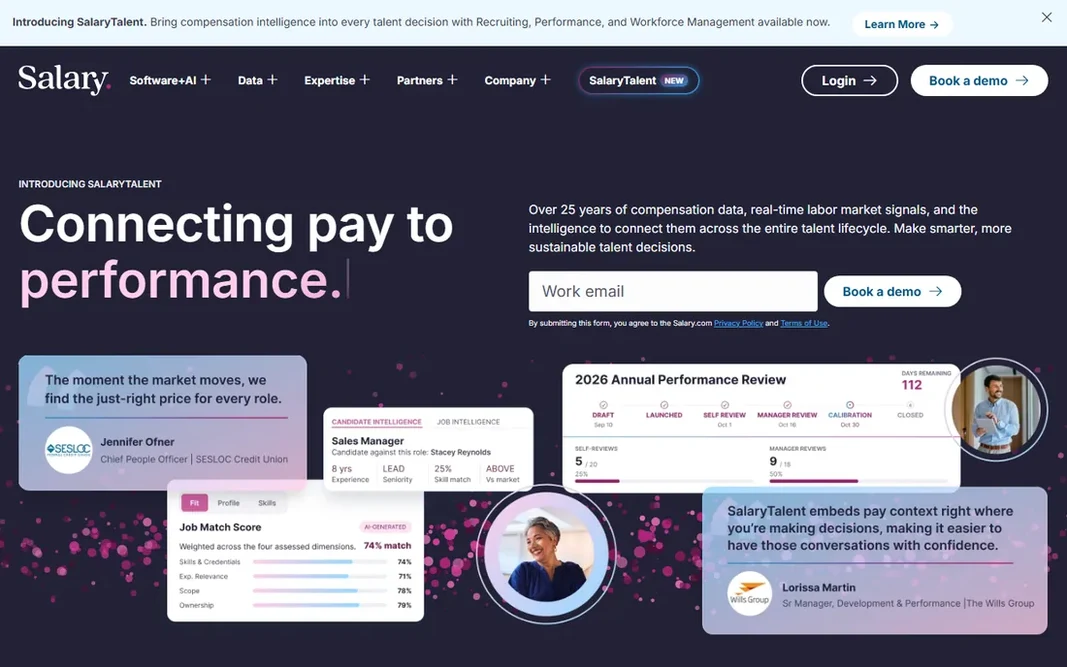
Think of Salary.com CompAnalyst for Compensation teams needing deep survey data and formal salary structures. CompAnalyst is the traditionalist's pick: the deepest conventional survey dataset, most solid in executive benchmarking, with 80+ prebuilt reports and pay-equity analysis in the suite. In daily use, setup takes time and benefits from a dedicated comp specialist. The trade-offs are the interface, which feels dated next to newer rivals. The fragmented portfolio: merit modeling (CompXL), pay equity and the employee portal are separate products, so budget for the bundle, not the base. No starting price is listed for Salary.com CompAnalyst here; confirm pricing on the vendor site. Salary.com CompAnalyst has no free tier. Drawbacks to consider: Dated; The portfolio is fragmented: merit execution.

Free plan: No

Website: salary.com

Strengths

  • 80+ prebuilt reports plus pay-equity analysis combining internal and external data
  • Automatic survey participation and salary-structure modeling

Watch out for

  • Pay equity and the employee portal are separate products
3

Carta Total Comp

US-based, VC-backed startups already on Carta for cap-table management
See website (quote-based; sold as an add-on to Carta's equity platform)

Carta Total Comp makes the most sense for US-based, VC-backed startups already on Carta for cap-table management. Setup is trivial for existing Carta customers. What users get: Cap-table integration ties compensation planning to ownership. Where it is weaker: Weakest outside the US. Carta Total Comp does not show a starting price in this comparison, so check the vendor site for current pricing. Carta Total Comp has no free tier.

Free plan: No

Website: carta.com

Strengths

  • 100+ HRIS integrations keep benchmarks continuously updated
  • Best-in-class private-market equity benchmarks from ~20,000 private businesses

Watch out for

  • Benchmarks include private companies only, with equity data far more mature than salary data
4

Pave

High-growth US tech startups making gives you weekly
See website (quote-based; no published pricing at any tier)

Pave is designed for high-growth US tech startups making gives you weekly. The honest catches are opacity and scope. What to check first: value relies on peers contributing data. This comparison lists no price for Pave; ask the vendor. Pave has no free tier. Reasons to shortlist it: Live benchmarking from 9,000+ integrated clients, with data refreshing continuously rather than annually.

Free plan: No

Website: pave.com

Strengths

  • Merit/bonus planning
  • Capable equity modeling for startups where choices are half the offer

Watch out for

  • Dataset skews to US tech
5

Deel Compensation

Globally distributed startups and mid-market businesses
From $15/employee/month (published; unusually transparent for global comp tooling)

Deel Compensation is a good fit for globally distributed startups and mid-market businesses. Deel Compensation is the global pick: salary benchmarking with multi-currency and localized compliance across 150+ countries, inside the HR and payroll product numerous distributed teams already run. For everyday use, best for lean comp teams prioritizing global coverage over survey depth. As for the details, at $15 per employee a month with published pricing, it undercuts most rivals whereas handling compensation reviews, budgeting dashboards and regional market insights. What you pay to start with Deel Compensation: From $15/employee/month. Deel Compensation does not include a free plan. Honest limits: No advanced modeling for bonuses or long-term incentives yet.

Free plan: No

Website: deel.com

Strengths

  • Reviews and payroll adjustments share one system
  • Sits inside Deel's HR/payroll system, so bands

Watch out for

  • Not as a primary survey
6

SimplyMerit

Mid-sized businesses (200-5,000 employees) that want to kill the merit-cycle spreadsheet
From $6,500/year (annual license by employee count; includes unlimited support; third-party listings vary)

For mid-sized firms (200-5,000 employees) that want to kill the merit-cycle spreadsheet, SimplyMerit is a natural candidate. SimplyMerit does one job, running salary, bonus and equity review cycles, and does it quick: the vendor promises go-live in under a week, with budget optimization, prorations, currency conversion, approval workflows and auto-generated adjustment letters. Worth adding: best for HR teams whose annual pain is the merit cycle itself instead of the data behind it. Where it falls short: Smaller vendor with a thinner integration ecosystem than product players. Main advantages: Purpose-built for merit cycles: budget optimization, prorations; currency conversion. Manager UX needs virtually no training, and value-for-money ratings are solid. Pricing scales with headcount from ~$6,500 per year with unlimited support. SimplyMerit pricing: From $6,500/year. As for free access: Free trial.

Free plan: Free trial

Website: simplymerit.com

Strengths

  • Live in 5 days or less per the vendor
  • Approval workflows and auto-generated adjustment letters

Watch out for

  • Not a benchmarking data source

Pre-purchase checklist

  • Ask Salary.com CompAnalyst, Carta Total Comp and Pave for a written quote, since no starting price is shown.
  • Use real work to test the free trial from SimplyMerit, rather than a demo project.
  • Before choosing Lattice Compensation, weigh its main limit: requires a Lattice base product: the $6/seat sits on top of Performance/Engagement seats, and the $4,000 annual minimum prices out tiny teams.
  • Get the contract term, renewal terms and any onboarding fees from Lattice Compensation in writing.
  • Total up the real monthly cost of SimplyMerit, including add-ons, extra users and usage-based fees.

FAQ

What is the best compensation software for startups?

The first pick on this list is Lattice Compensation, because it suits SMBs and mid-market businesses already running Lattice for performance. Salary.com CompAnalyst is better for Compensation teams needing deep survey data and formal salary structures, and Carta Total Comp for US-based, VC-backed startups already on Carta for cap-table management. Check price and limits against your own needs before choosing.

Does any tool for compensation management software here have a free plan?

A permanent free plan is not offered by Lattice Compensation, SimplyMerit or the other tools here. SimplyMerit offer a trial. Plan a short evaluation period instead.

Do these tools publish their prices?

Not all of them. Salary.com CompAnalyst, Carta Total Comp and Pave publish no starting price, so expect a quote request for those. The rest, Lattice Compensation included, show a starting price, though seats and billing terms still change the final cost.

How are the tools for compensation management software ordered?

The order follows typical fit for compensation management software, with Lattice Compensation first and SimplyMerit last, then price clarity and free access. It is editorial judgement, not a score, so another team could rank the tools differently.

Can I try these options before paying?

Often, yes. SimplyMerit offers a free trial. Use your own data and a real task during the test, and check what the free tier or trial limits before you rely on it.