HR and Workforce · Researched comparison

Freelance Platforms Buyer's Guide: 7 Tools for 2026

TaskReports may earn a fee from some links on this page, and some placements are paid and labelled. Neither one decides the order. See our disclosure.

The short answer

For continuing client relationships at lower fees, Guru is where this list starts. If your case is different, PeoplePerHour suits UK and European clients, fixed-price Hourlies and Malt suits European freelance hiring, particularly France. Details, prices and limits for the rest of the 7 tools are below.

On this page

Key takeaways

  • Top of the list is Guru, which targets continuing client relationships at lower fees.
  • One limit worth knowing about PeoplePerHour: 20 percent opening fee is steep for first-time client relationships.
  • Freelancer.com suits competitive bidding on tight budgets.
  • Free plans are common here: 6 of 7 tools have one, including Guru, PeoplePerHour, Malt and Upwork.

Quick comparison

ToolSuited toKey limitationPrice fromFree option
---------------
GuruContinuing client relationships at lower feesThe lowest fees require a monthly membershipSee websiteYes
PeoplePerHourUK and European clients, fixed-price HourliesStrongest talent density is UK and EuropeSee websiteYes
MaltEuropean freelance hiring, notably FranceWeaker coverage outside EuropeSee websiteYes
FlexJobsVetted remote job listings without scamsNo free tier, so you pay before you can apply$2.95 for 14-day accessNo
UpworkLong-term contracts across almost any skillProposal Connects cost money, so applying is not freeSee websiteYes
FiverrPackaged services bought in a handful of clicksBuyer service fee adds 5.5 percent to every orderSee websiteYes
Freelancer.comCompetitive bidding on tight budgetsBidding culture can push rates and quality downSee websiteYes

How we chose

Pricing pages, product documentation and feature lists were the main sources, and every entry carries at least one honest drawback. Treat prices as a snapshot: vendors change plans often, so check the vendor site for the figure that applies today. The sequence is a judgement call: typical use case first, then pricing transparency, then free access. Use the profiles to check fit.

★ Best overall

Guru

Continuing client relationships at lower fees

  • WorkRooms keep communication and files in one place
  • SafePay escrow with adaptable payment terms
PriceSee website
See Guru pricing

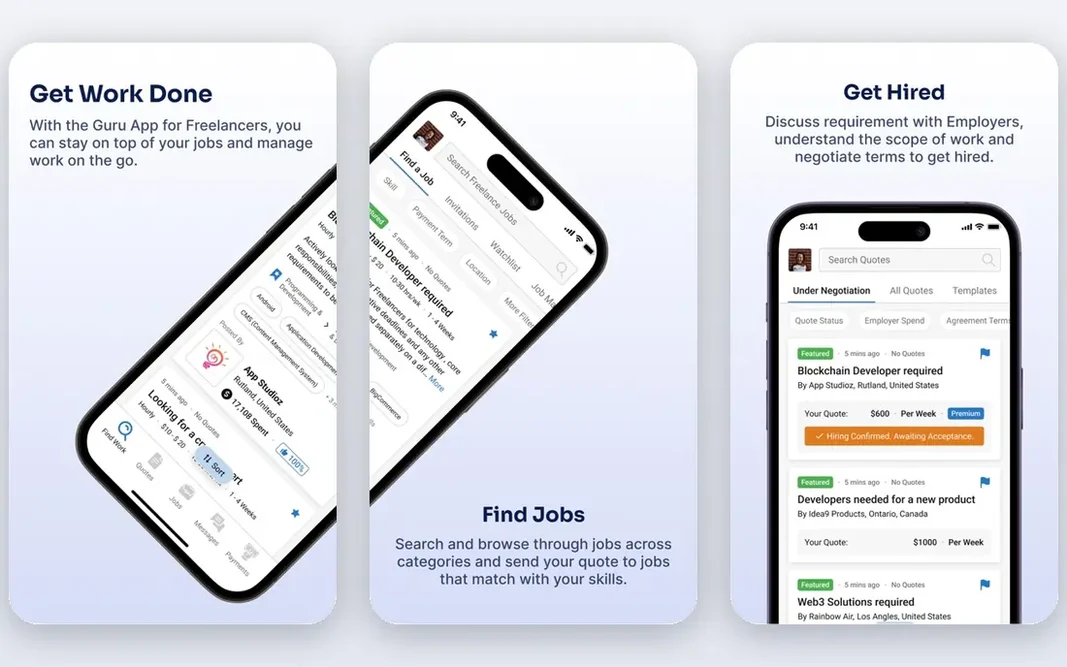
Think of Guru for continuing client relationships at lower fees. Joining and posting jobs is free. From a buyer's view, Guru has been running since 1998: agreements support fixed-price, hourly, task-based and recurring payments, and dedicated WorkRooms keep messages, milestones and files attached to each job. Where it is weaker: Smaller marketplace and fewer job postings than the giants. On top of that, the free level charges a 9 percent fee, and premium memberships bring it down to 5 percent, which beats Upwork and Fiverr for freelancers billing steady volume. The main limit is marketplace size: there are fewer listings here than on the biggest systems. So it rewards freelancers who bring their own clients and use Guru as a low-fee billing and contract layer. Guru shows no starting price here, so confirm the cost on the vendor site. Free access exists with Guru.

Price: See website

Free plan: Yes

Website: guru.com

Watch out for

  • The lowest fees need a monthly membership
2

PeoplePerHour

UK and European clients, fixed-price Hourlies
See website

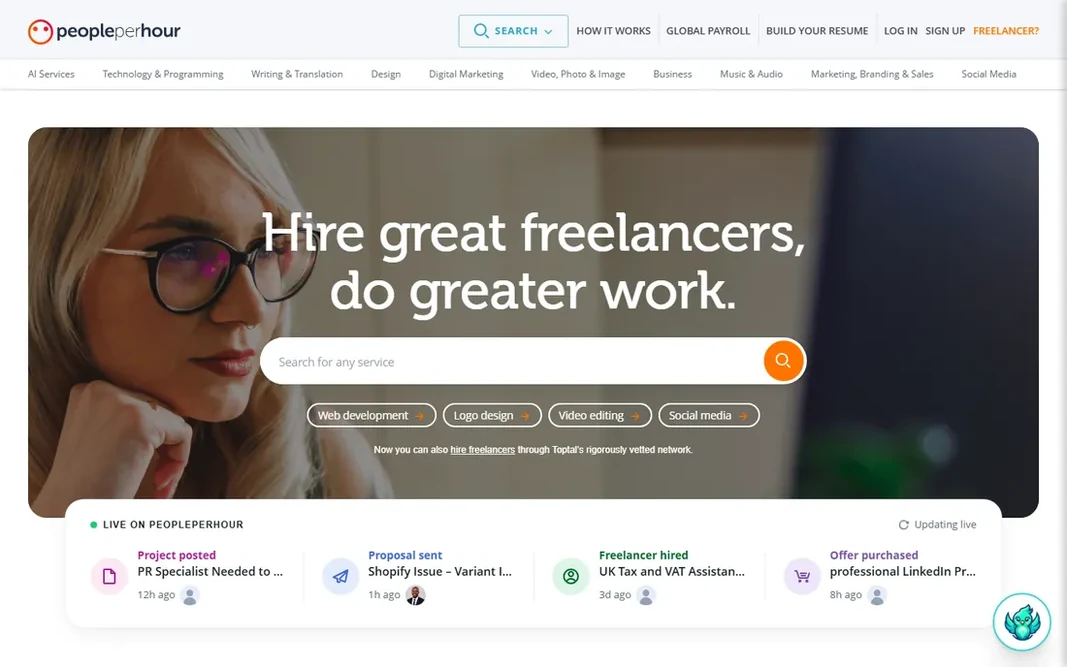
Where PeoplePerHour fits: UK and European clients, fixed-price Hourlies. PeoplePerHour is an UK-first marketplace pairing project bidding with Hourlies, its packaged fixed-price services. Where it is weaker: Most solid talent density is UK and Europe. No starting price is listed for PeoplePerHour here; confirm pricing on the vendor site. A free plan is available with PeoplePerHour.

Free plan: Yes

Website: peopleperhour.com

Strengths

  • Hourlies make fixed-price services simple to buy
  • Fee drops to 3.5 percent on high lifetime billing per client

Watch out for

  • 20 percent opening fee is steep for first-time client relationships
3

Malt

European freelance hiring, notably France
See website

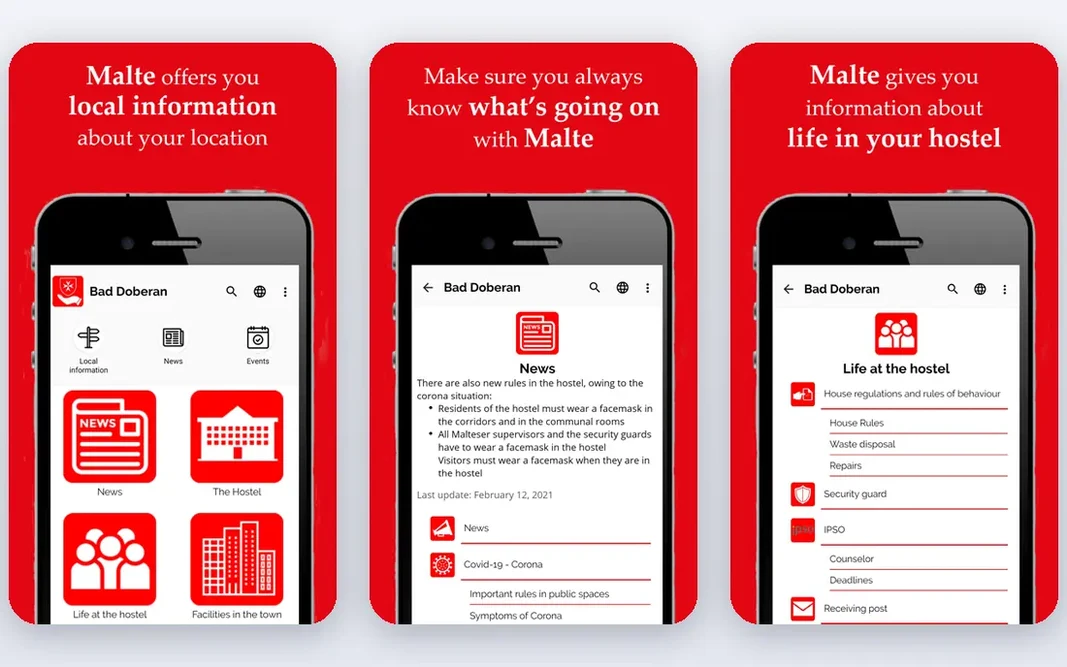
Malt is built with European freelance hiring, notably France in mind. It spans tech, data, design, marketing and consulting. More specifically, if you sell services to European businesses, Malt puts you in front of buyers the US-centric products barely reach. Watch-outs: Weaker coverage outside Europe. From a buyer's view, projects are insured and compliance handling is built in, which matters for corporate clients. Malt charges 10 percent per contract for clients found through the product, dropping to 5 percent after six months of collaboration, and 2 percent if you invite your own clients to bill through Malt. Malt does not show a starting price in this comparison, so check the vendor site for current pricing. Free access exists with Malt.

Free plan: Yes

Website: malt.com

Strengths

  • Strong presence in France and multiple European markets
  • Fee drops with longer client relationships

Watch out for

  • Commission is 10 percent for new client relationships
4

FlexJobs

Vetted remote job listings without scams
$2.95 for 14-day access

FlexJobs is a good fit for Vetted remote job listings without scams. The result is a job board with no ads, no commission-only postings and no multilevel marketing junk. That screening is the whole value proposition. On top of that, there is no free level, though free members can preview short listing descriptions. It is not a marketplace, so there is no bidding, no escrow and no commission math to do. Pricing comes from FlexJobs' own pricing page: $2.95 buys 14 days of full access, with longer plans at $9.95 a month for three months or $5.95 a month billed yearly. A money-back guarantee in the first 14 days. What you pay to start with FlexJobs: $2.95 for 14-day access. No free plan comes with FlexJobs. Honest limits: Subscription model makes it a poor fit for one-off gigs.

Free plan: No

Website: flexjobs.com

Strengths

  • Refund available within the first 14 days
  • 50 plus career categories beyond tech

Watch out for

  • No free level, so you pay before you can apply
5

Upwork

Long-term contracts across almost any skill
See website

In short, Upwork is for long-term contracts across almost any skill. Upwork is the biggest freelance marketplace: almost any skill is here, from mobile development to bookkeeping, and hourly and fixed-price contracts are both supported. Also, most freelancers land near 10 percent, per current guides. From a buyer's view, the fee structure changed in May 2025 and is worth understanding. From a buyer's view, joining is free, clients post jobs free, and payment protection runs through escrow. Check the vendor site for Upwork pricing; none is listed in this comparison. You can start on Upwork without paying. Where it is weaker: Proposal Connects cost money, so applying is not free.

Free plan: Yes

Website: upwork.com

Strengths

  • Enormous talent pool with hourly and fixed-price contracts
  • Escrow protection on milestones

Watch out for

  • Fee is set per contract and is hard to predict at the start
6

Fiverr

Packaged services bought in a handful of clicks
See website

Choose Fiverr for packaged services bought in a handful of clicks. For a client who wants a logo or a landing page rewrite without writing a job post, nothing is quicker. Joining is free for both sides, and payment only moves when the order completes. the main limit is the fee. Buyers pay a 5.5 percent service fee on top, plus a small flat fee on orders under $200. So the combined take sits around 25 percent. Fiverr is superb for repeatable, well-defined services, but if you sell here, price the commission into your gigs from day one. Fiverr does not show a starting price in this comparison, so check the vendor site for current pricing. A free plan is available with Fiverr. Where it falls short: Flat 20 percent seller commission is the steepest on this list.

Free plan: Yes

Website: fiverr.com

Strengths

  • Huge category range with fast delivery options
  • Gig packaging makes pricing predictable for buyers

Watch out for

  • Buyer service fee adds 5.5 percent to every order
7

Freelancer.com

Competitive bidding on tight budgets
See website

Freelancer.com works best for competitive bidding on tight budgets. Freelancers pay a 10 percent project fee or $5, whichever is greater, on fixed-price work, with the same 10 percent on hourly payments, and clients pay roughly 3 percent. In daily use, milestone payments hold funds until the client releases them. Where it falls short: 10 percent freelancer fee with a $5 minimum stings on small jobs. The real caveat is cultural: with so plenty of freelancers bidding openly, prices drift downward, and picking the cheapest bid commonly buys rework. It works best for well-specified, budget-sensitive projects where you review portfolios carefully rather than sorting by price. Freelancer.com does not show a starting price in this comparison, so check the vendor site for current pricing. Freelancer.com includes a free tier.

Free plan: Yes

Website: freelancer.com

Strengths

  • Free job posting with a huge volume of bids
  • Contests let you see design concepts before paying

Watch out for

  • Bidding culture can push rates and quality down

FAQ

Should I be on more than one freelance product?

Normally yes. A typical setup is one high-volume marketplace for discovery plus one low-fee system for billing repeat clients. That way you are not paying 20 percent on work you sourced yourself.

Is Upwork or Fiverr better for beginners?

Fiverr is simpler to start on if your service can be packaged with a fixed scope and price, since buyers come to your gig. Upwork fits beginners who can write solid proposals and want hourly or longer contracts.

Is Guru the right pick for everyone comparing freelance platforms?

No single tool suits every team. Guru comes first because it fits ongoing client relationships at lower fees, while PeoplePerHour suits UK and European clients, fixed-price Hourlies and Malt suits European freelance hiring, especially France. Match the tool to your own size, budget and workflow before deciding.

Do these tools publish their prices?

Not all of them. Guru, PeoplePerHour, Malt and others publish no starting price, so expect a quote request for those. The rest, FlexJobs included, show a starting price, though seats and billing terms still change the final cost.

Can I try these options before paying?

Often, yes. Guru, PeoplePerHour, Malt and others have a free plan. Use your own data and a real task during the test, and check what the free tier or trial limits before you rely on it.

Which product is a good match for finding remote jobs instead of gigs?

The first pick on this list is Guru, because it suits continuing client relationships at lower fees. PeoplePerHour is better for UK and European clients, fixed-price Hourlies, and Malt for European freelance hiring, particularly France. Check price and limits against your own needs before choosing.