Data and Analytics · Researched comparison

7 Data Integration Software, Compared by Cost and Features

TaskReports may earn a fee from some links on this page, and some placements are paid and labelled. Neither one decides the order. See our disclosure.

The short answer

This list puts Rivery first for teams wanting ELT plus reverse ETL and orchestration in one product. Alternatives: Matillion for Data teams standardized on Snowflake, Databricks, BigQuery or Redshift, and Hevo Data for analytics teams that want no-code pipelines running in minutes. Prices, free plans and limits for all 7 tools follow.

On this page

Key takeaways

  • The list opens with Rivery, aimed at teams wanting ELT plus reverse ETL and orchestration in one product.
  • Coupler.io suits business teams automating reports, dashboards and spreadsheet data flows.
  • Free plans exist at 4 of 7 tools (Fivetran, Skyvia, Estuary, Coupler.io).
  • For the cheapest start, look at Coupler.io: From $24/month.
  • Fivetran comes with a trade-off: usage-based MAR pricing is hard to forecast as connector count grows.

Quick comparison

ToolIdeal forStarting priceOfficial site
------------
RiveryTeams wanting ELT plus reverse ETL and orchestration in one systemFrom $0.75 per creditrivery.io
MatillionData teams standardized on Snowflake, Databricks, BigQuery or RedshiftSee websitematillion.com
Hevo DataAnalytics teams that want no-code pipelines running in minutesSee websitehevodata.com
FivetranTeams that want completely managed ELT with minimal maintenanceSee websitefivetran.com
SkyviaBusiness users needing integration, backup and live data access togetherFrom $99/monthskyvia.com
EstuaryTeams needing live CDC and streaming without Kafka complexity$0.50 per GB of data movedestuary.dev
Coupler.ioBusiness teams automating reports, dashboards and spreadsheet data flowsFrom $24/monthcoupler.io
★ Best overall

Rivery

Teams wanting ELT plus reverse ETL and orchestration in one system

  • Published per-credit pricing beginning at $0.75
  • End-to-end system including ingestion, transformation
PriceFrom $0.75 per credit (usage-based)
See Rivery pricing

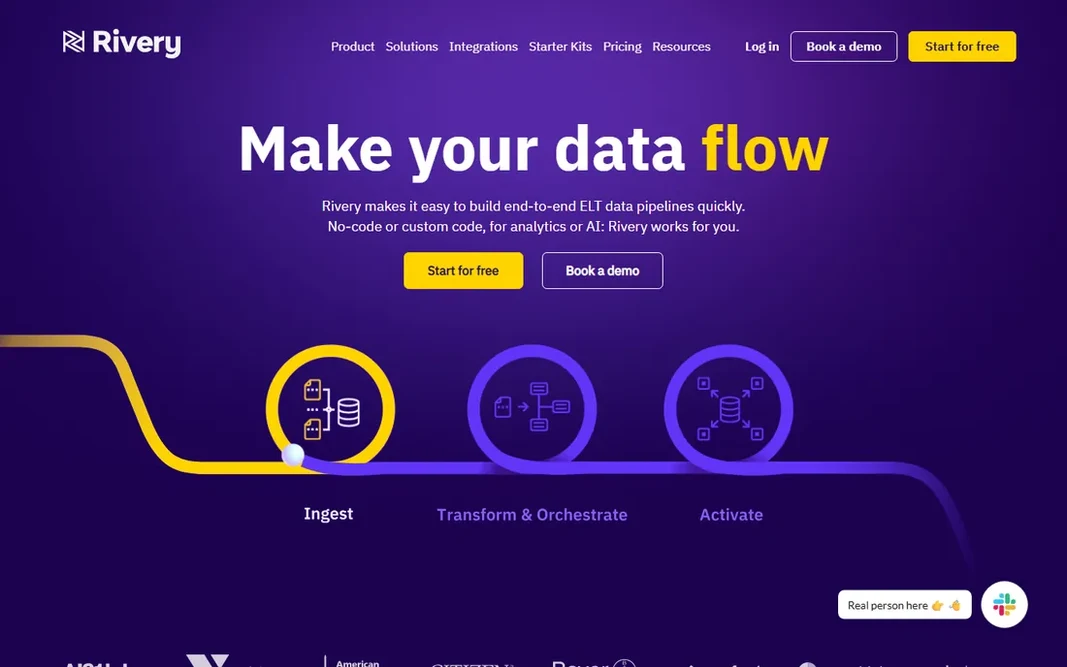
Rivery is aimed squarely at teams wanting ELT plus reverse ETL and orchestration in one product. The 200-plus managed connectors need no code or API maintenance, and the custom connector builder spans any REST API your business relies on. For everyday use, support quality is the standout in reviews: engineering-led, around the clock, and consistently top-rated in the category. What works well: 200-plus completely managed connectors with custom REST API connector builder. The main drawbacks: Credit-based pricing still needs usage modeling to forecast. Worth adding: the honest catch is that credits are still a meter you have to learn. Pricing is published and credit-based, beginning at $0.75 per credit, with database sources billed by volume moved and API sources by execution. Entry price for Rivery: From $0.75 per credit. Trial and free access: Free trial.

Price: From $0.75 per credit (usage-based)

Free plan: Free trial

Website: rivery.io

Watch out for

  • Public cloud SaaS, with no self-hosted choice for regulated environments
2

Matillion

Data teams standardized on Snowflake, Databricks, BigQuery or Redshift
See website (credit-based Data Productivity Cloud)

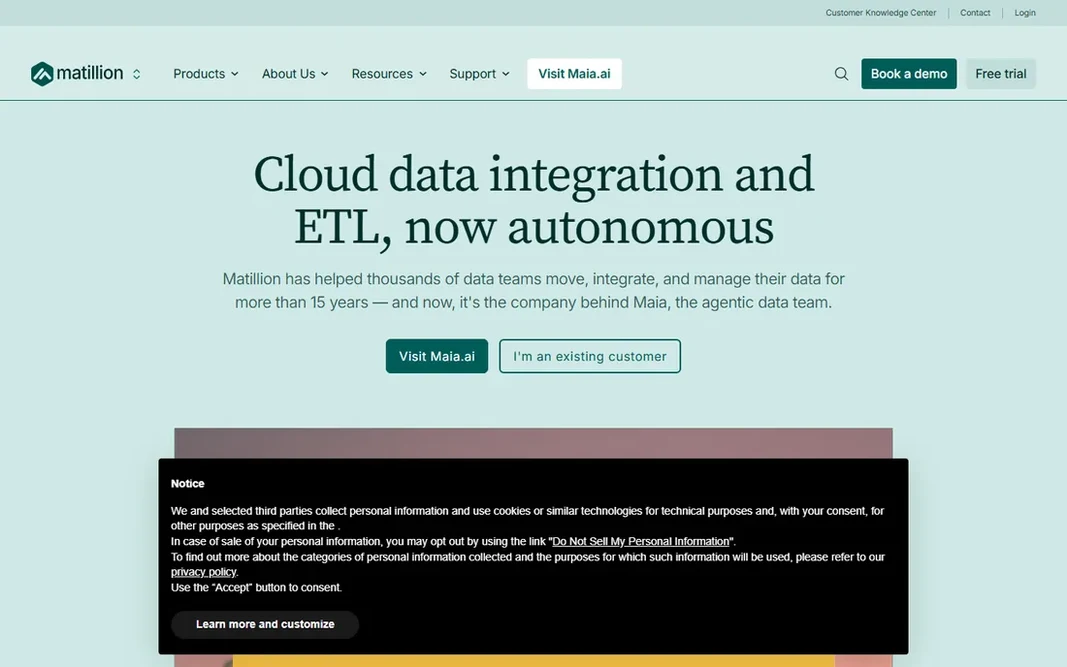
Matillion is built with Data teams standardized on Snowflake, Databricks, BigQuery or Redshift in mind. Matillion is the ELT product for teams that already picked their warehouse. More specifically, if you have to land data in Postgres, files, or operational systems, it is not the right tool. This is a data-team tool, not a business-user tool. The Data Productivity Cloud (now called Maia Foundation) hands you a visual designer for extraction, loading and transformation pipelines that push compute down into Snowflake, Databricks, BigQuery or Redshift. The honest catch is fit. More specifically, if your destination is one of the big four warehouses, Matillion is purpose-built and efficient. No starting price is listed for Matillion here; confirm pricing on the vendor site. On free options: Free trial. Strengths: Orchestration.

Free plan: Free trial

Website: matillion.com

Strengths

  • Long track record (founded 2011) with enterprise support choices
  • Drag-and-drop pipeline designer purpose-built for the big four cloud warehouses

Watch out for

  • No published starting price, so budgeting starts with a sales conversation
3

Hevo Data

Analytics teams that want no-code pipelines running in minutes
See website

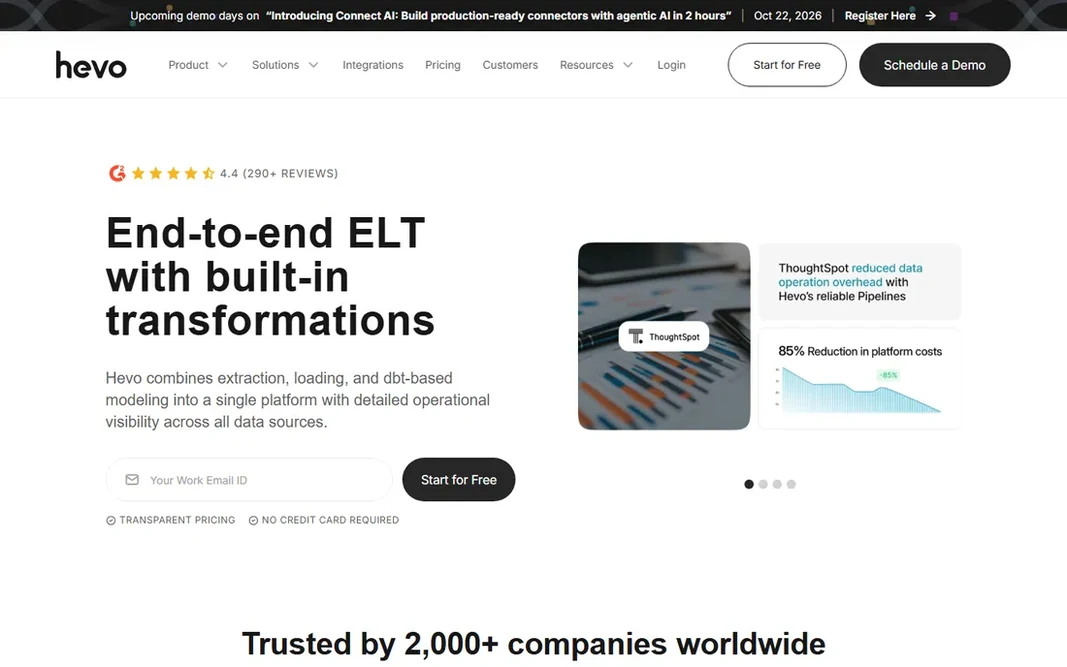
For analytics teams that want no-code pipelines running in minutes, Hevo Data is a natural candidate. The system takes care of schema changes automatically, recovers failed records on its own, and contains pipeline monitoring with alerts, which spans the operational basics. Worth adding: if you need published pricing or an exotic connector, shortlist elsewhere. the main limit is transparency. Hevo publishes no prices, so you cannot do the comparison math without talking to sales. As for the details, Hevo Data pitches simplicity: link a source and a warehouse in a handful of clicks, with no code required. In practice, the connector count (150-plus) is solid for mainstream SaaS and databases but thinner than the leaders for unusual sources. This comparison lists no price for Hevo Data; ask the vendor. Free access: Free trial. Honest limits: No published pricing, so every serious evaluation goes through sales.

Free plan: Free trial

Website: hevodata.com

Strengths

  • SaaS apps and warehouses
  • No-code pipeline setup geared toward analytics and business users

Watch out for

  • Smaller connector library than Fivetran or Airbyte
4

Fivetran

Teams that want completely managed ELT with minimal maintenance
See website (usage-based, billed per million MAR)

Fivetran makes the most sense for teams that want completely managed ELT with minimal maintenance. You link a source, pick a destination warehouse, and Fivetran deals with extraction, loading, schema drift and re-syncs. On top of that, annual contracts start at a $12,000 minimum spend, so Fivetran is really an annual-budget conversation for serious use. As for the details, the connector library is the deepest in the business, including SaaS apps, databases, ERPs, files and event streams. On top of that, pricing is based on Monthly Active Rows per connector, and costs scale with data change volume instead of with anything you can easily cap. The honest catch is the bill. No starting price is listed for Fivetran here; confirm pricing on the vendor site. Fivetran includes a free tier. Drawbacks to consider: Usage-based MAR pricing is hard to forecast as connector count grows.

Free plan: Yes

Website: fivetran.com

Strengths

  • Free plan handles low volumes with Standard features
  • Completely managed connectors that adapt to schema and API changes automatically

Watch out for

  • Enterprise database connectors and 1-minute syncs need Enterprise or Business Critical plans
5

Skyvia

Business users needing integration, backup and live data access together
From $99/month (Data Integration)

Skyvia makes the most sense for business users needing integration, backup and live data access together. Sync frequency boosts as you pay more, so near-real-time needs get pricey. On top of that, for a data team building a warehouse-first stack, pick a specialist. Drawbacks to consider: Scheduling frequency and advanced ETL features are gated by pricing level. premium Data Integration plans start at $99 a month. Beyond ETL/ELT pipelines, it takes care of cloud backup of SaaS data, live OData-style data access without moving data, automation workflows and browser-based SQL querying. Price to start with Skyvia: From $99/month. Skyvia offers a free plan.

Free plan: Yes

Website: skyvia.com

Strengths

  • Querying and live data access
  • Free plan with 10,000 records a month

Watch out for

  • 200-plus connectors
6

Estuary

Teams needing live CDC and streaming without Kafka complexity
$0.50 per GB of data moved (usage-based)

Estuary targets teams needing real-time CDC and streaming without Kafka complexity. Estuary is the modern answer to real-time data movement. Rather than batch-only syncs, it records database changes as they happen (CDC), streams them through durable collections, and provides to warehouses, lakes, operational systems or AI destinations on schedules from live to hourly. As for the details, the connector library (150-plus) handles the important databases and SaaS apps but not the long tail. Beyond that, the main limit is maturity of breadth. Teams that want point-and-click visual transformations will miss them: Estuary expects SQL or TypeScript, with dbt integration for warehouse-side work. Starting cost for Estuary: $0.50 per GB of data moved. You can start on Estuary without paying. Honest limits: smaller than the biggest libraries.

Free plan: Yes

Website: estuary.dev

Strengths

  • Straightforward $0.50/GB pricing with a genuinely free Developer level
  • Bring-your-own-cloud deployment for data control

Watch out for

  • Transformations lean on SQL and TypeScript instead of a visual designer
7

Coupler.io

Business teams automating reports, dashboards and spreadsheet data flows
From $24/month (billed yearly)

Coupler.io is designed for business teams automating reports, dashboards and spreadsheet data flows. Coupler.io is data integration for people who live in spreadsheets and dashboards. It pulls data from 400-plus business apps into Google Sheets, Excel, Looker Studio, Power BI, Tableau or BigQuery, with a no-code transformation editor and scheduled refreshes. Drawbacks to consider: Made for reporting data flows. Where it shines: 400-plus sources with destinations from Google Sheets to BigQuery and Power BI. Beyond that, if your goal is a central warehouse, it is the wrong category. In practice, Coupler.io is designed for reporting pipelines: marketing spend, sales activity, finance metrics flowing into dashboards. What you pay to start with Coupler.io: From $24/month. Coupler.io has a free plan.

Free plan: Yes

Website: coupler.io

Strengths

  • Ready-made dashboard templates for marketing
  • Account-based pricing (pay per connected source, not per user or row)

Watch out for

  • Refresh frequency and AI features are tiered by plan

FAQ

Can I try these options before paying?

Often, yes. Fivetran, Skyvia, Estuary and Coupler.io have a free plan and Rivery, Matillion and Hevo Data offer a free trial. Use your own data and a real task during the test, and check what the free tier or trial limits before you rely on it.

What is the difference between ETL and ELT?

ETL transforms data before loading it into the destination; ELT loads raw data first and transforms it inside the warehouse with SQL. ELT dominates modern stacks since cloud warehouses made in-warehouse transformation cheap.

What is the cheapest option for data integration software in this list?

On published monthly entry prices, Coupler.io is the lowest here at $24/month. Entry price is only part of the cost, because seats, add-ons and billing terms can change the total.

How are the tools for data integration software ordered?

The order follows typical fit for data integration software, with Rivery first and Coupler.io last, then price clarity and free access. It is editorial judgement, not a score, so another team could rank the tools differently.

Is Rivery the right pick for everyone comparing data integration software?

No single tool suits every team. Rivery comes first because it fits teams wanting ELT plus reverse ETL and orchestration in one platform, while Matillion suits Data teams standardized on Snowflake, Databricks, BigQuery or Redshift and Hevo Data suits analytics teams that want no-code pipelines running in minutes. Match the tool to your own size, budget and workflow before deciding.