IT Management · Researched comparison

Shortlist: 6 Best Network Management Software Options for 2026

TaskReports may earn a fee from some links on this page, and some placements are paid and labelled. Neither one decides the order. See our disclosure.

The short answer

Nagios XI leads the list, best for admins who want maximum extensibility on infrastructure they own. For a different need, Datadog covers cloud-native teams that want network monitoring inside full observability and Paessler PRTG covers SMBs that want capable monitoring with a genuinely free tier. Details, prices and limits for the rest of the 6 tools are below.

On this page

Key takeaways

  • The list opens with Nagios XI, aimed at admins who want maximum extensibility on infrastructure they own.
  • Only Paessler PRTG offers a free plan among these 6 tools.
  • A fair warning about Paessler PRTG: sensor counting confuses new buyers.
  • For enterprises that want deep network performance analytics, SolarWinds NPM is worth a look.

Quick comparison

ToolBest forFree accessVendor site
------------
Nagios XIAdmins who want maximum extensibility on infrastructure they ownFree trialnagios.com
DatadogCloud-native teams that want network monitoring inside full observabilityFree trialdatadoghq.com
Paessler PRTGSMBs that want capable monitoringYespaessler.com
LogicMonitorEnterprises wanting agentless SaaS monitoring without infrastructureFree triallogicmonitor.com
ManageEngine OpManagerIT teams that want monitoring inside a broader managementFree trialmanageengine.com
SolarWinds NPMEnterprises that want deep network performance analyticsFree trialsolarwinds.com

How we chose

TaskReports looked at what each vendor publishes: pricing, plan limits, feature coverage for network management software and stated drawbacks. No hands-on testing is claimed. Where a price is missing, the vendor does not list one publicly or ties it to a quote. Always confirm before budgeting. The sequence is a judgement call: typical use case first, then pricing transparency, then free access. Use the profiles to check fit.

★ Best overall

Nagios XI

Admins who want maximum extensibility on infrastructure they own

  • One-time licensing ($1,995 Standard, $3,495 Enterprise) with no subscription
  • The plugin ecosystem is unmatched after decades
Price$1,995 one-time (Standard Edition)
See Nagios XI pricing

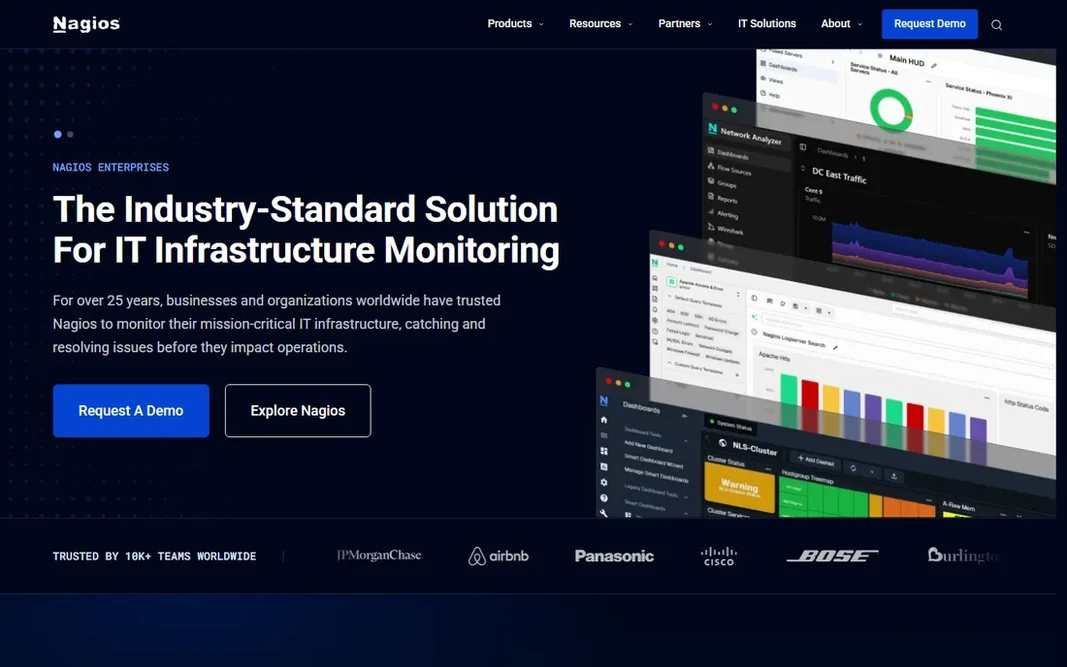
Nagios XI makes the most sense for admins who want maximum extensibility on infrastructure they own. For the team that wants to own its monitoring stack outright, Nagios XI is the buy. In practice, standard Edition at $1,995 one-time (Enterprise $3,495) buys the web interface, configuration wizards, dashboards and reporting on top of the Nagios Core engine, with thousands of community plugins extending it to anything. Downsides: Scaling to huge estates needs architecture work. It runs entirely on your infrastructure, which fits regulated and air-gapped environments. As for the details, the experience is old-school: feature-rich, file-driven in places, and visually dated next to SaaS competitors. Nagios XI cost at the entry level: $1,995 one-time. Trial and free access: Free trial.

Price: $1,995 one-time (Standard Edition)

Free plan: Free trial

Website: nagios.com

Watch out for

  • Configuration leans on files and wizards instead of modern UX
2

Datadog

Cloud-native teams that want network monitoring inside full observability
$15/host/month (Infrastructure Pro)

Where Datadog fits: cloud-native teams that want network monitoring inside full observability. Pure network depth is thinner than SolarWinds NPM. Where it is weaker: Costs scale quick with host and metric volume. Datadog is the observability product that also does network monitoring. Entry price for Datadog: $15/host/month. Free plan details: Free trial.

Free plan: Free trial

Website: datadoghq.com

Strengths

  • Network monitoring unified with logs, APM
  • Very good cloud and container coverage

Watch out for

  • Network-specific depth is thinner than SolarWinds
3

Paessler PRTG

SMBs that want capable monitoring with a genuinely free level
Free up to 100 sensors; from $2,149/year (PRTG 500)

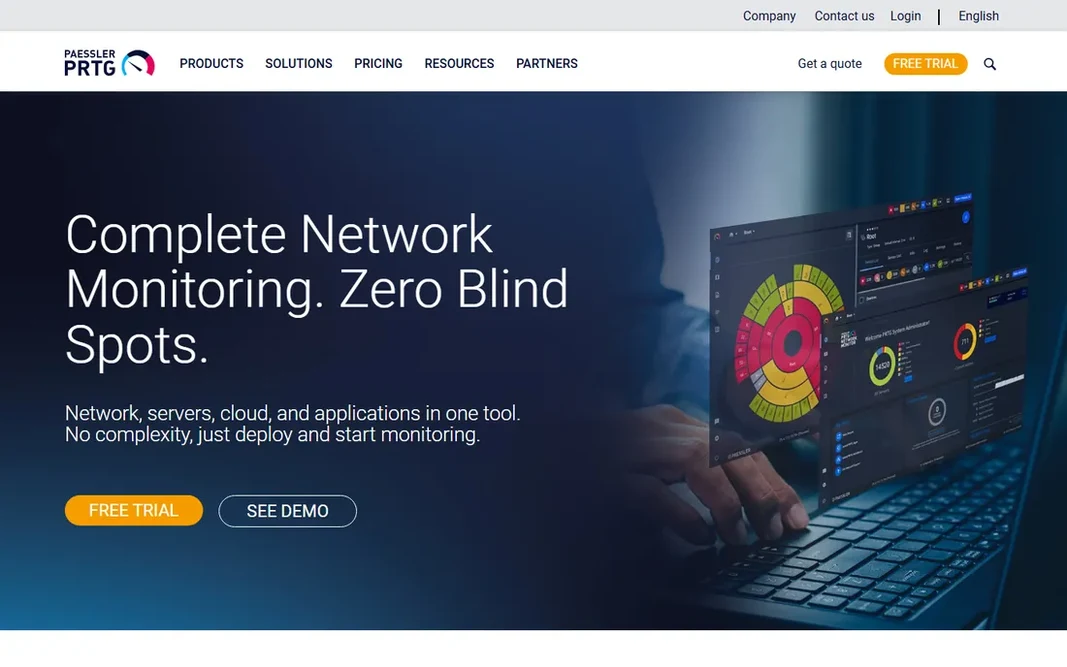
Paessler PRTG works best for SMBs that want capable monitoring with a genuinely free level. Install it, let auto-discovery find your devices, and you have monitoring with alerting in an afternoon. Worth adding: the sensor model is the thing to understand: one device can consume numerous sensors, so count before buying. The free tier handles 100 sensors indefinitely, which takes care of a small office or lab. In daily use, premium levels are published and sensor-based: PRTG 500 from $2,149 a year, scaling to 10,000 sensors and enterprise licensing. Starting cost for Paessler PRTG: Free up to 100 sensors. Paessler PRTG has a free plan. Downsides: Very large networks get pricey per-sensor.

Free plan: Yes

Website: paessler.com

Strengths

  • Published sensor-based pricing that scales predictably
  • 100 sensors free forever handles small networks

Watch out for

  • The interface presents its age
4

LogicMonitor

Enterprises wanting agentless SaaS monitoring without infrastructure
See website (custom quote only)

LogicMonitor works best for enterprises wanting agentless SaaS monitoring without infrastructure. LogicMonitor delivers infrastructure monitoring as SaaS. Limits to weigh: Quote-based pricing. Collectors installed locally gather data from networks, servers and cloud accounts and feed the cloud product. So there is no monitoring server to maintain. LogicMonitor does not show a starting price in this comparison, so check the vendor site for current pricing. Free access: Free trial.

Free plan: Free trial

Website: logicmonitor.com

Strengths

  • Wide coverage: networks, servers, cloud
  • SaaS product with agentless collection via local collectors

Watch out for

  • SaaS-only will not suit air-gapped requirements
5

ManageEngine OpManager

IT teams that want monitoring inside a broader management suite
See website (custom quote only)

ManageEngine OpManager is aimed squarely at IT teams that want monitoring inside a broader management suite. For the IT generalist team that wants one throat to choke, OpManager suits. Network performance monitoring sits alongside server monitoring, application monitoring, network configuration management and IP address management, all from ManageEngine. The main drawbacks: Interface consistency varies across the suite. Beyond that, the tradeoff of suite buying applies: each module is decent instead of best-in-class. From a buyer's view, for the team standardizing on the suite, the integration and the single vendor relationship matter. ManageEngine OpManager shows no starting price here, so confirm the cost on the vendor site. Free plan details: Free trial.

Free plan: Free trial

Website: manageengine.com

Strengths

  • Low-cost positioning against SolarWinds
  • Decent multi-vendor device coverage

Watch out for

  • The breadth means individual modules lag best-of-breed tools
6

SolarWinds NPM

Enterprises that want deep network performance analytics
See website (custom quote only)

SolarWinds NPM is a good fit for enterprises that want deep network performance analytics. SolarWinds Network Performance Monitor is the enterprise network monitoring standard. The Thwack community and template library mean someone has already built the monitor template for your hardware. Check the vendor site for SolarWinds NPM pricing; none is listed in this comparison. Free plan details: Free trial. What to check first: Quote-based pricing with no published numbers. What SolarWinds NPM does well: Mature multi-vendor device support.

Free plan: Free trial

Website: solarwinds.com

Strengths

  • The deepest network-specific feature set: NetPath
  • Huge community and template library

Watch out for

  • The 2020 supply-chain attack still comes up in procurement reviews

FAQ

Can I try these options before paying?

Often, yes. Paessler PRTG has a free plan and Nagios XI, Datadog, LogicMonitor and others offer a free trial. Use your own data and a real task during the test, and check what the free tier or trial limits before you rely on it.

Is Nagios XI the right pick for everyone comparing network management software?

No single tool suits every team. Nagios XI comes first because it fits admins who want maximum extensibility on infrastructure they own, while Datadog suits cloud-native teams that want network monitoring inside full observability and Paessler PRTG suits SMBs that want capable monitoring with a genuinely free tier. Match the tool to your own size, budget and workflow before deciding.

Which options for network management software have a free plan?

Paessler PRTG is the only tool in this list with a free plan. Free plans usually cap users, projects or features, so check the limits on the vendor page. Several others offer a trial instead.

What is the difference between network monitoring and observability?

Network monitoring watches devices, links and traffic health. Observability (Datadog, LogicMonitor) correlates network data with application performance, logs and infrastructure metrics for root-cause analysis. Large cloud-native teams normally want observability; network-focused teams want dedicated monitoring.

Do these tools publish their prices?

Not all of them. LogicMonitor, ManageEngine OpManager and SolarWinds NPM publish no starting price, so expect a quote request for those. The rest, Nagios XI included, show a starting price, though seats and billing terms still change the final cost.