
Web Hosting · Researched comparison

Website Platform for SEO Buyer's Guide: 7 Tools for 2026

TaskReports may earn a fee from some links on this page, and some placements are paid and labelled. Neither one decides the order. See our disclosure.

The short answer

For quick marketing sites for startups, Framer is where this list starts. For a different need, Webflow covers designer-built sites with clean code and Shopify covers ecommerce product SEO. The remaining 4 options are covered below with prices and limits.

On this page

Key takeaways

  • Top of the list is Framer, which targets quick marketing sites for startups.
  • For small firms wanting an all-in-one editor, Wix is worth a look.
  • The main caution on Framer: CMS is lighter than Webflow's for large content libraries.
  • Starting prices begin at ~$3/month with Hostinger Website Builder.

Quick comparison

ToolBest fitMain limitStarts atFree plan
---------------
FramerQuick marketing sites for startupsWeak for ecommerceSee websiteYes
WebflowDesigner-built sites with clean codeSteeper learning curve than drag-and-drop builders$14/monthYes
ShopifyEcommerce product SEOBlog is serviceable but not a strength$39/monthFree trial (3 days)
Hostinger Website BuilderCheapest way to launch a siteBasic SEO toolset with fewer advanced controls~$3/monthNo
WordPress.orgMaximum SEO controlSecurity is your responsibilityFreeYes
DudaAgencies building client sites at scaleEcommerce needs add-ons$19/monthFree trial (14 days)
WixSmall companies wanting an all-in-one editorLower plans cap storage$17/monthYes
★ Best overall

Framer

Quick marketing sites for startups

  • AI-assisted first drafts accelerate launches
  • Quick page loads and straightforward pricing
PriceSee website
See Framer pricing

Framer is aimed squarely at quick marketing sites for startups. The tradeoff is content depth. Framer has become the landing spot for teams fleeing Webflow's pricing complexity. Downsides: Weak for ecommerce. The CMS manages marketing-scale content fine but is not aimed at a thousand-article library, and there is no real ecommerce story. For a startup marketing site or a SaaS homepage with a docs section, it provides comparable visual output to Webflow at more straightforward per-site pricing. Framer does not show a starting price in this comparison, so check the vendor site for current pricing. Free access exists with Framer.

Price: See website

Free plan: Yes

Website: framer.com

Watch out for

  • CMS is lighter than Webflow's for large content libraries
2

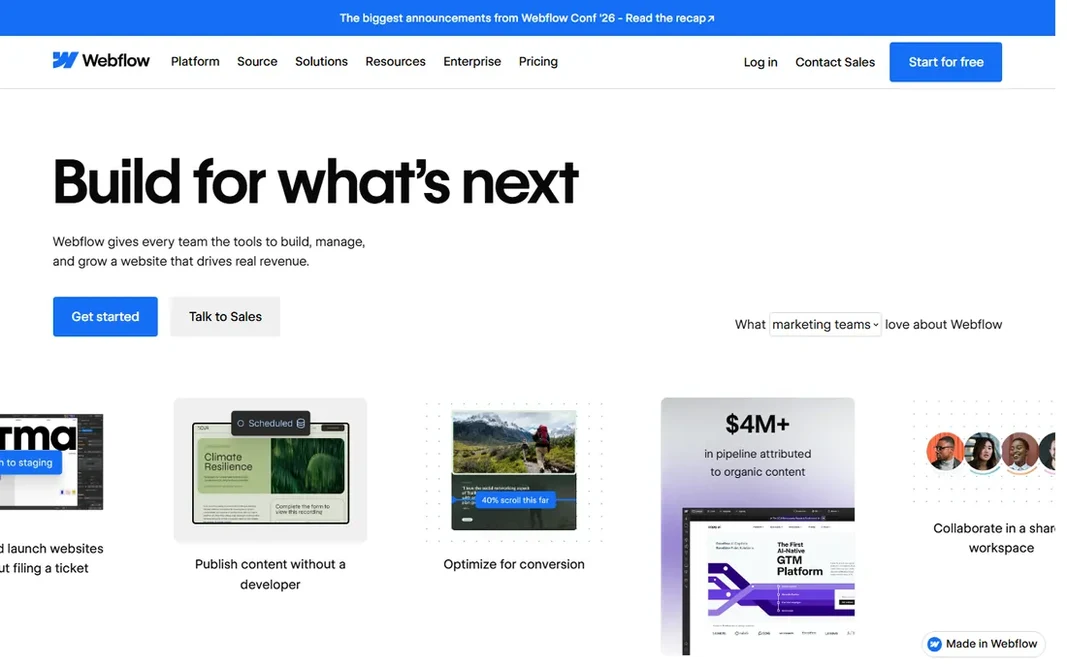
Webflow

Designer-built sites with clean code
$14/month (billed yearly)

Webflow is aimed squarely at designer-built sites with clean code. The legacy Editor is being retired in 2026 in favor of the newer CMS editing experience, which changes how non-technical editors update content. Every live site needs its own Site Plan, and a blog needs the CMS level or higher, so a small portfolio of client or company sites brings up quick. Also, Webflow is the product agencies reach for when they want WordPress-level technical SEO without managing servers. Entry price for Webflow: $14/month. Webflow offers a free plan. Main advantages: Native schema. Points against: No code export on hosted plans, so leaving means rebuilding.

Free plan: Yes

Website: webflow.com

Strengths

  • Visual CMS that marketers can use without breaking design
  • Redirect and robots.txt controls

Watch out for

  • Steeper ramp-up time than drag-and-drop builders

3

Shopify

Ecommerce product SEO
$39/month (billed per month)

Where Shopify fits: ecommerce product SEO. Hosting, security, speed and structured data for products are handled, which lets a small store focus on category pages, product content and link building. The URL rigidity is the real gripe. Where it falls short: Blog is serviceable but not a strength. From a buyer's view, if you sell products, Shopify is still the default answer. If you publish as much as you sell, pair it with a more solid content system or look at Webflow. Beyond that, the 2026 plans run $39 to $399 per month on monthly billing, with the middle plan renamed Grow, and new keeps get a 3-day trial followed by $1 per month for the first three months. For everyday use, products live under /products/ and collections under /collections/ with no way to change that path structure, which forces workarounds for certain international or taxonomy strategies. More specifically, Blogging exists but feels secondary. The starting price for Shopify: $39/month. Free options: Free trial (3 days).

Free plan: Free trial (3 days)

Website: shopify.com

Strengths

  • 24/7 support on every plan
  • Automatic sitemaps

Watch out for

  • Fixed URL structure for products and collections limits permalink strategy
4

Hostinger Website Builder

Cheapest way to launch a site
~$3/month (intro pricing)

Choose Hostinger Website Builder for cheapest way to launch a site. If the site starts earning, plan a move to a product with a higher ceiling instead of fighting the builder's limits. Hostinger wins on one metric: cost. On top of that, expect a thinner SEO toolkit than anything above it. In daily use, intro pricing around $3 per month makes it the cheapest path to a live site with a custom domain. The AI builder produces a workable first draft in minutes. Treat Hostinger as a launchpad. For a side project, a test site or a business that just needs to exist online, the value is hard to argue with. The starting price for Hostinger Website Builder: ~$3/month. No free plan comes with Hostinger Website Builder. Watch-outs: Entry-level SEO toolset with fewer advanced controls.

Free plan: No

Website: hostinger.com

Strengths

  • AI-assisted site generation gets you live rapidly
  • Hosting and builder bundled in one bill

Watch out for

  • Renewal prices rise after the intro period
5

WordPress.org

Maximum SEO control
Free (self-hosted; hosting costs extra)

Where WordPress.org fits: maximum SEO control. It exposes the whole technical layer: custom schema types through plugins or code, complete URL control, XML sitemaps, redirect managers, multilingual setups with WPML or Polylang. A plugin ecosystem that has an answer for nearly every SEO edge case. Worth adding: budget real money for managed hosting, keep the plugin count low, and plan for someone to manage updates. In daily use, the main limit is that WordPress provides you freedom and bills you in maintenance. WordPress rewards discipline and punishes neglect, which is why it suits teams with either technical skill in-house or a retained developer. Price to start with WordPress.org: Free. A free plan is available with WordPress.org. Watch-outs: Plugin conflicts and update maintenance fall on you. What works well: Portable site that can move hosts.

Free plan: Yes

Website: wordpress.org

Strengths

  • Robots.txt and site architecture
  • Full control over schema, redirects

Watch out for

  • Speed depends entirely on hosting and theme choices
6

Duda

Agencies building client sites at scale
$19/month (billed yearly)

Pick Duda if this describes you: agencies building client sites at scale. The SEO toolkit handles the essentials, and hosting on AWS keeps pages quick. Where it is weaker: Ecommerce needs extras. From a buyer's view, plans start at $19 per month billed yearly for one site. What you pay to start with Duda: $19/month. Free options: Free trial (14 days).

Free plan: Free trial (14 days)

Website: duda.co

Strengths

  • Quick AWS hosting with solid uptime
  • Aimed at agencies with client management and white labeling

Watch out for

  • Pitched at agencies, so single-site owners overpay for features they will not use
7

Wix

Small companies wanting an all-in-one editor
$17/month (billed yearly)

For small businesses wanting an all-in-one editor, Wix is a natural candidate. Wix has spent years closing the SEO gap its critics point to, and the 2026 version is a legitimate choice for small business sites. The SEO Wiz setup flow, automatic sitemaps, bulk meta editing and an app market for extras handle the fundamentals well. Where it falls short: No real site export, so migration means a full rebuild. For a local service business that needs a site, booking and a small store in one place, the Core plan at $29 per month is reasonable value. The honest limitation is structural, not a conspiracy against rankings. The starting price for Wix: $17/month. Free access exists with Wix. Highlights: structured data and robots.txt editing included.

Free plan: Yes

Website: wix.com

Strengths

  • Redirects
  • Free plan lets you test before paying

Watch out for

  • Lower plans cap storage

FAQ

Can I try these tools before paying?

Often, yes. Framer, Webflow, WordPress.org and Wix have a free plan and Shopify and Duda offer a free trial. Use your own data and a real task during the test, and check what the free tier or trial limits before you rely on it.

How are the tools for website platform for SEO ordered?

The order follows typical fit for website platform for SEO, with Framer first and Wix last, then price clarity and free access. It is editorial judgement, not a score, so another team could rank the tools differently.

Do I have to know code to rank well on these systems?

Code only becomes necessary for advanced work like custom schema or template-level speed fixes, and that is where Webflow or WordPress pull ahead.

Which options for website platform for SEO have a free plan?

On this list, Framer, Webflow, WordPress.org and Wix include a free plan. Caps on seats, usage or features are common, so test the free plan against your real workload. Several others offer a trial instead.

Is Shopify bad for SEO due to its URL structure?

Not bad, just rigid. The fixed /products/ and /collections/ paths limit some permalink strategies, but Shopify keeps rank very well with solid category pages, product content and links. The URL structure is a constraint to work around, not a reason to avoid the system.

What is the cheapest option for website platform for SEO in this list?

On published monthly entry prices, Hostinger Website Builder is the lowest here at ~$3/month. Entry price is only part of the cost, because seats, add-ons and billing terms can change the total.