
Productivity · Researched comparison

Comparing 7 AI Writing Software for Research Papers in 2026

TaskReports may earn a fee from some links on this page, and some placements are paid and labelled. Neither one decides the order. See our disclosure.

The short answer

Start with Scite if you need verifying citations and finding supporting or contradicting evidence. If your case is different, Wordvice AI suits researchers who want proofreading, paraphrasing and translation in one toolkit and Jenni AI suits researchers and students drafting academic papers with AI help. The remaining 4 options are covered below with prices and limits.

On this page

Key takeaways

  • Scite is the opening pick, best for verifying citations and finding supporting or contradicting evidence.
  • Check the limits for Jenni AI before you commit: pricing and free-tier limits are not published on the homepage.
  • Free plans are common here: 6 of 7 tools have one, including Wordvice AI, Jenni AI, SciSpace and Paperpal.
  • Trinka suits non-native English speakers polishing academic manuscripts.
  • Expect to ask for a quote from Scite, Jenni AI, SciSpace and others; the other tools show a starting price.

Quick comparison

ToolPrice fromFree optionWatch out forIdeal for
---------------
SciteSee websiteNot statedNot a writing editorVerifying citations and finding supporting or contradicting evidence
Wordvice AI$9.95/monthYesFree tier's 5,000-word monthly cap covers roughly one paperResearchers who want proofreading, paraphrasing and translation in one toolkit
Jenni AISee websiteYesDrafting assistance still needs careful fact-checkingResearchers and students drafting academic papers with AI help
SciSpaceSee websiteYesPricing is not published on the homepageResearchers who work straight from PDFs and want AI explanations
PaperpalSee websiteYesPricing is not published on the homepageResearchers who want one workspace from literature search to submission
QuillBotSee websiteYesGeneral-purpose rather than research-specificParaphrasing and summarizing research text rapidly
TrinkaSee websiteYesThe deepest features sit on premium tiersNon-native English speakers polishing academic manuscripts

How we chose

TaskReports used vendor pricing pages and product documentation as the base, then compared plans, free access and documented limits for 7 tools. Treat prices as a snapshot: vendors change plans often, so check the vendor site for the figure that applies today. The ranking is editorial: typical fit first, then clear pricing, then free access. If your needs are unusual, read the profiles rather than relying on position.

★ Best overall

Scite

Verifying citations and finding supporting or contradicting evidence

  • Books and patents
  • Search across 300M+ articles, preprints
PriceSee website
See Scite pricing

Scite serves verifying citations and finding supporting or contradicting evidence. For literature reviews and discussion sections, running your key references through Scite before submission is one of the highest-value habits in research writing. Trade-offs to know: not a writing editor. Check current pricing on the vendor's site. This comparison lists no price for Scite; ask the vendor. Free plan details: Not stated.

Price: See website

Free plan: Not stated

Website: scite.ai

Watch out for

  • Pricing is not published on the homepage
2

Wordvice AI

Researchers who want proofreading, paraphrasing and translation in one toolkit
$9.95/month (Premium; Basic plan free with 5,000 words/month)

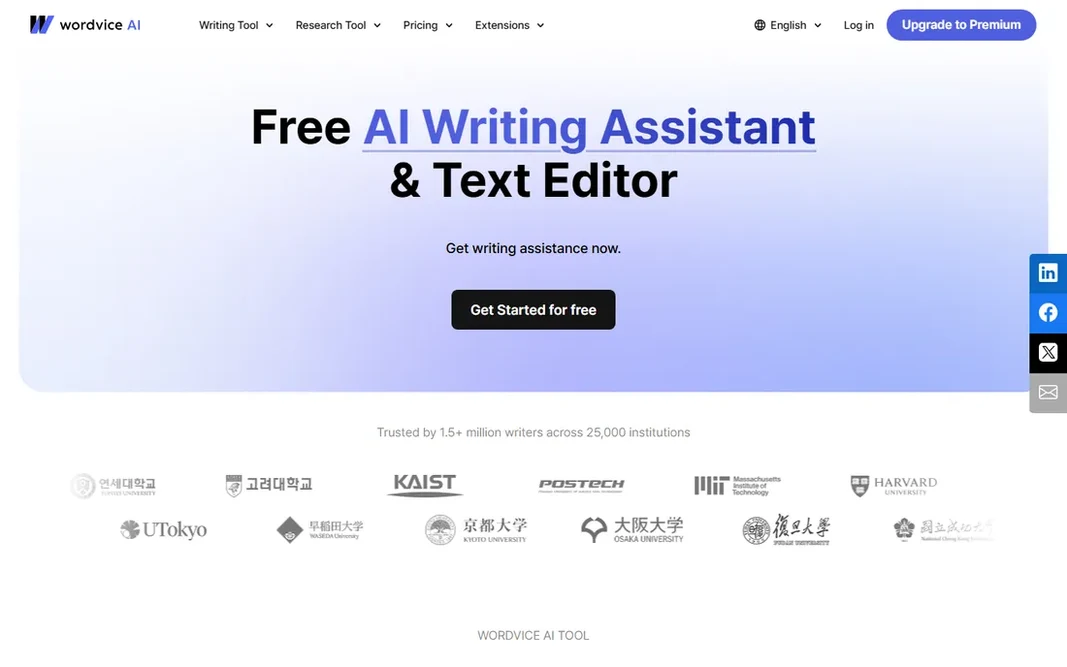
Wordvice AI targets researchers who want proofreading, paraphrasing and translation in one toolkit. Wordvice AI wins on commercial clarity, which is rare in this category. The 5,000-word free cap is enough to test seriously but not to live on. Drawbacks to consider: Free level's 5,000-word monthly cap handles roughly one paper. Where Wordvice AI stands out: Premium from $9.95/month. The toolkit handles proofreading, paraphrasing, translation, summarization, plagiarism checking and AI detection, all pitched at academic and professional writing. The pricing page states it plainly: a free Basic plan with 5,000 words a month, Premium from $9.95 a month with a million words. A Team plan from $8.45 a month. Wordvice AI pricing: $9.95/month. A free plan is available with Wordvice AI.

Free plan: Yes

Website: wordvice.ai

Strengths

  • Full toolkit including proofreader, paraphraser, translator
  • Clear published pricing: free Basic with 5,000 words/month

Watch out for

  • AI detector and plagiarism checker are separate tools in the suite
3

Jenni AI

Researchers and students drafting academic papers with AI help
See website

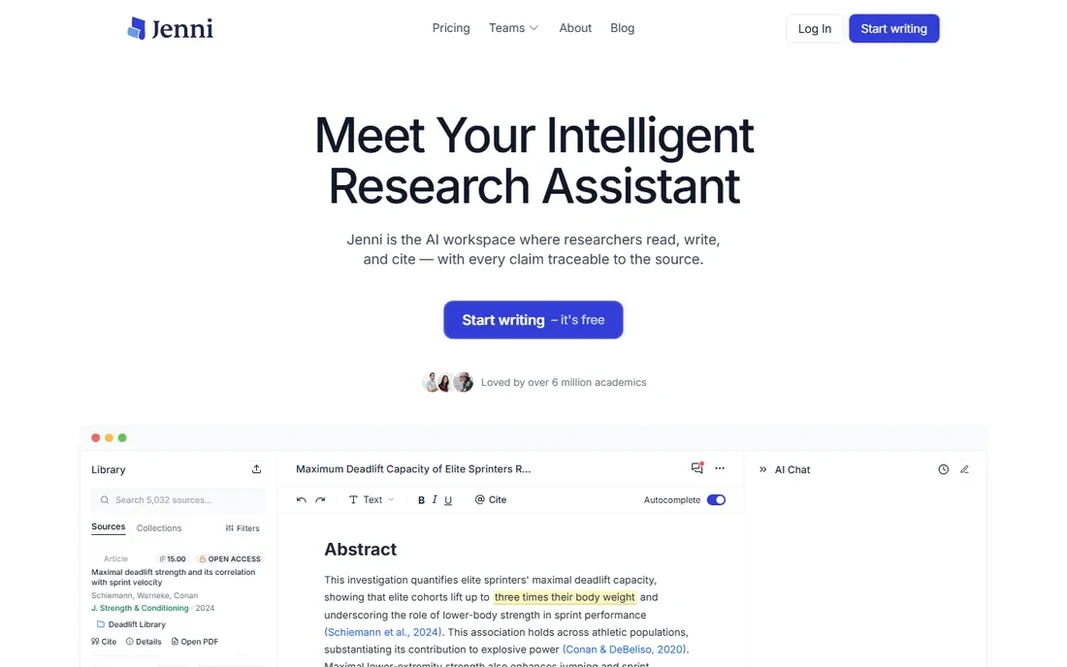
For researchers and students drafting academic papers with AI help, Jenni AI is a natural candidate. Jenni AI is the drafting assistant most associated with academic writing. Unlike general chatbots, it is built around the way papers are written: you draft in an editor, the AI suggests continuations in academic tone, and citations are handled as part of the workflow instead of pasted in afterward. Downsides: Drafting assistance still needs careful fact-checking. Strengths: Purpose-built for academic writing with citation support in the editor. For students facing the blank page on a term paper or researchers drafting a manuscript section, it removes the startup friction. For everyday use, the caution applies to every drafting tool: the AI writes fluently about things it may not know. Jenni AI does not show a starting price in this comparison, so check the vendor site for current pricing. A free plan is available with Jenni AI.

Free plan: Yes

Website: jenni.ai

Strengths

  • Papers and theses
  • Autocomplete and drafting assistance tuned to scholarly tone

Watch out for

  • Pricing and free-tier limits are not published on the homepage
4

SciSpace

Researchers who work straight from PDFs and want AI explanations
See website

SciSpace is built with researchers who work straight from PDFs and want AI explanations in mind. SciSpace is built around the way researchers actually encounter knowledge: as PDFs. Main advantages: Explains complicated papers in plain language; Chat-with-PDF. Where it falls short: Pricing is not published on the homepage. On top of that, upload a paper and chat with it, get explanations of dense passages, produce literature reviews and draft with the AI writer, then format citations. SciSpace shows no starting price here, so confirm the cost on the vendor site. SciSpace includes a free tier.

Free plan: Yes

Website: scispace.com

Strengths

  • Literature review
  • AI writer

Watch out for

  • The all-in-one scope overlaps with multiple tools on this list
5

Paperpal

Researchers who want one workspace from literature search to submission
See website

Paperpal serves researchers who want one workspace from literature search to submission. The reference check is the standout feature: it catches broken links and AI-hallucinated references before a journal does. On top of that, researchers who just need proofreading will find more straightforward tools quicker to adopt. No starting price is listed for Paperpal here; confirm pricing on the vendor site. Paperpal includes a free tier. Reasons to shortlist it: Handles writing, citations, paraphrasing. Limits to weigh: The breadth means a learning curve for the full checker suite.

Free plan: Yes

Website: paperpal.com

Strengths

  • 10,000+ citation styles supported
  • Checks references for errors and hallucinated citations

Watch out for

  • Pricing is not published on the homepage
6

QuillBot

Paraphrasing and summarizing research text rapidly
See website

QuillBot is designed for paraphrasing and summarizing research text rapidly. It is a writing tool that researchers use, not a research tool. Use it for the language work, and deal with evidence with the tools aimed at it. Check the vendor site for QuillBot pricing; none is listed in this comparison. QuillBot has a free plan. Downsides: Heavy paraphrasing of sources needs care to avoid accidental plagiarism.

Free plan: Yes

Website: quillbot.com

Strengths

  • The best-known paraphraser, with several modes for controlling output
  • Summarizer

Watch out for

  • General-purpose instead of research-specific
7

Trinka

Non-native English speakers polishing academic manuscripts
See website (free plan; vendor lists range up to $20/month)

Trinka works best for non-native English speakers polishing academic manuscripts. Trinka's pitch is precision: where generic grammar checkers correct conversational English, Trinka understands academic and technical language, including domain-specific phrasing in research papers and theses. It supplies style guide support for major academic formats, a Microsoft Word add-in, file proofreading and a paraphraser, plus plagiarism and AI detection. What Trinka does well: ACS and AGU. As for the details, for researchers writing in English as a second language, the academic tuning makes it meaningfully better than a general-purpose checker. For everyday use, the vendor's own page lists a price range of $0 to $20 per month. From a buyer's view, heavy users (proofreading full manuscripts, running plagiarism checks) will need credits or a premium level. Also, the free plan spans advanced grammar and language checks, which is enough for plenty of students. This comparison lists no price for Trinka; ask the vendor. Free access exists with Trinka. What to check first: The deepest features sit on premium levels.

Free plan: Yes

Website: trinka.ai

Strengths

  • Grammar and style engine trained specifically on academic and technical writing
  • Style guides for APA, IEEE

Watch out for

  • Credit-based system for some features can be confusing

FAQ

Is it cheating to use AI writing tools for research papers?

It relies on your institution's and journal's policies, not on the tool. Most universities allow AI for editing, brainstorming and summarizing with disclosure. Submitting AI-generated text as your own work without disclosure is academic misconduct a maximum of institutions.

What is the best free AI writing tool for students?

Start with Scite if you need verifying citations and finding supporting or contradicting evidence. Wordvice AI is the better match for researchers who want proofreading, paraphrasing and translation in one toolkit, and Jenni AI for researchers and students drafting academic papers with AI help. The best choice depends on budget, team size and workflow.

Which AI tool is a good match for writing a research paper from scratch?

The first pick on this list is Scite, because it suits verifying citations and finding supporting or contradicting evidence. Wordvice AI is better for researchers who want proofreading, paraphrasing and translation in one toolkit, and Jenni AI for researchers and students drafting academic papers with AI help. Check price and limits against your own needs before choosing.

Is Scite the right pick for everyone comparing AI writing software for research papers?

No single tool suits every team. Scite comes first because it fits verifying citations and finding supporting or contradicting evidence, while Wordvice AI suits researchers who want proofreading, paraphrasing and translation in one toolkit and Jenni AI suits researchers and students drafting academic papers with AI help. Match the tool to your own size, budget and workflow before deciding.

Which options for AI writing software for research papers have a free plan?

6 of the 7 tools have a free plan, including Wordvice AI, Jenni AI, SciSpace and Paperpal. Free plans usually cap users, projects or features, so check the limits on the vendor page.

Can I try these tools before paying?

Often, yes. Wordvice AI, Jenni AI, SciSpace and others have a free plan. Use your own data and a real task during the test, and check what the free tier or trial limits before you rely on it.